
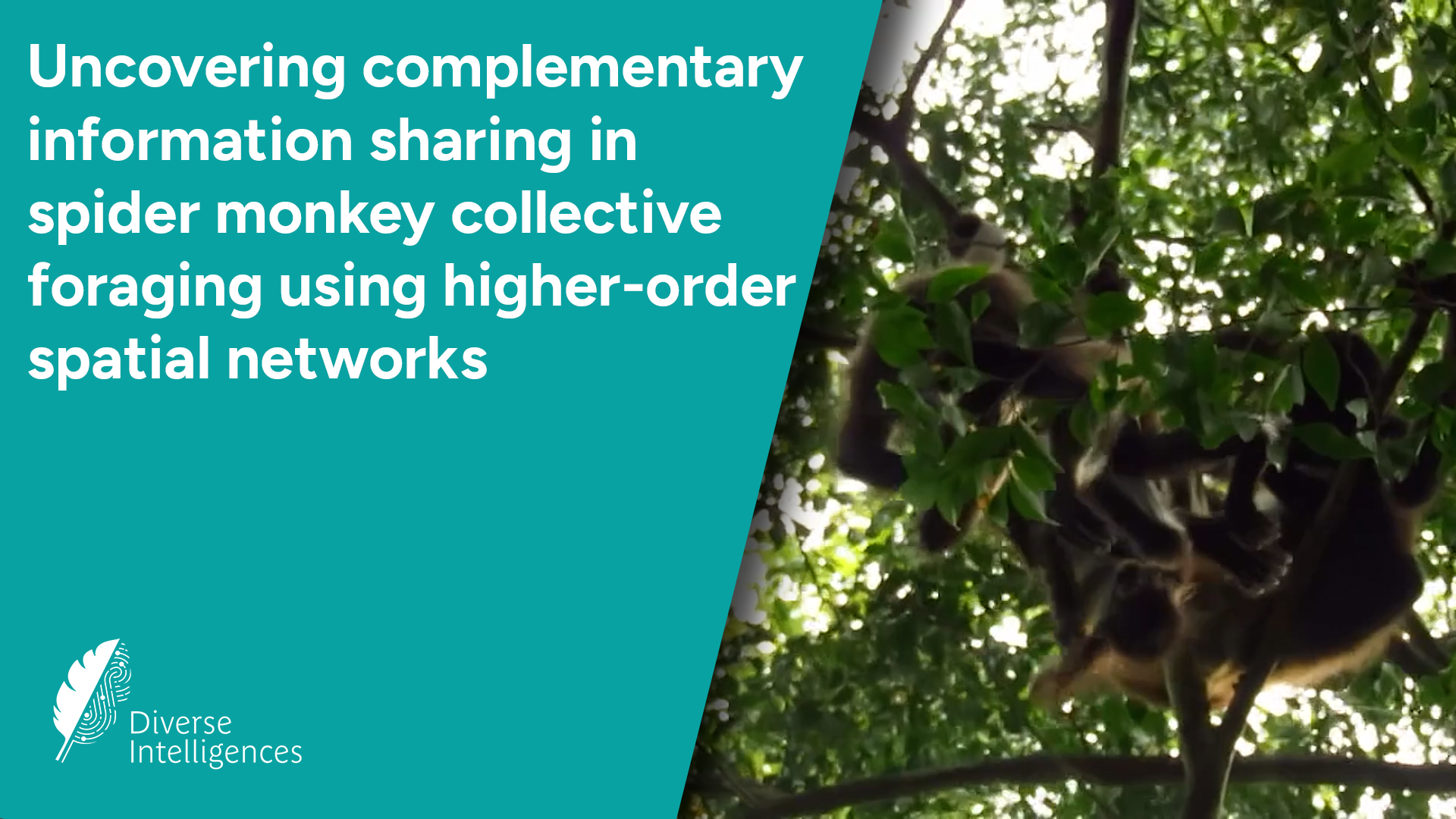
A recent paper by Ramos-Fernandez, Walker, Silk, Boyer & Smith Aguilar, published in NPJ Complexity (2025), explores how spider monkeys share complementary foraging information in fission–fusion societies.
By modelling overlaps in individual core ranges, they show how groups balance redundant and unique knowledge, potentially enabling the monkeys to adapt collectively to ever changing environments.
Read the full paper here, and watch our explainer video below.
Paper abstract:
Collectives are often able to process information in a distributed fashion, surpassing each individual member’s processing capacity. In fission-fusion dynamics, where group members come together and split from others often, sharing complementary information about uniquely known foraging areas could allow a group to track a heterogenous foraging environment better than any group member on its own.
We analyse the partial overlaps between individual spider monkey core ranges, which we assume represent the knowledge of an individual during a given season. Sets of individuals with complementary overlaps are identified, showing a balance between redundantly and uniquely known portions, and we use simplicial complexes to represent these higher-order interactions.
The structures of the simplicial complexes show holes in various dimensions, revealing complementarity in the foraging information that is being shared. We propose that the complex spatial networks arising from fission-fusion dynamics allow for adaptive, collective processing of foraging information in dynamic environments.